


Michalis A. Michael
November 2, 2026
Avoiding social listening doesn't remove adverse events from the internet. It only means you stop hearing what patients, HCPs and carers are saying.
Why adverse events stop pharma from listening on social media, what the rules require, and how to set up a process your safety team can trust.
Adverse events are the main reason pharma companies hold back from social listening. Once a post describing a possible side effect is in your data, you may be responsible for assessing it and reporting it on time. A missed report can lead to regulatory findings and serious fines, so many teams decide it is safer not to look.
That decision has a cost. It leaves marketing, insights and medical teams without one of the richest sources of unprompted patient and HCP opinion. This guide explains what counts as an adverse event online, what the rules expect, and what a process looks like that your pharmacovigilance team can sign off.
This article is general information, not regulatory advice. Always confirm requirements with your own pharmacovigilance and regulatory teams.
What counts as an adverse event
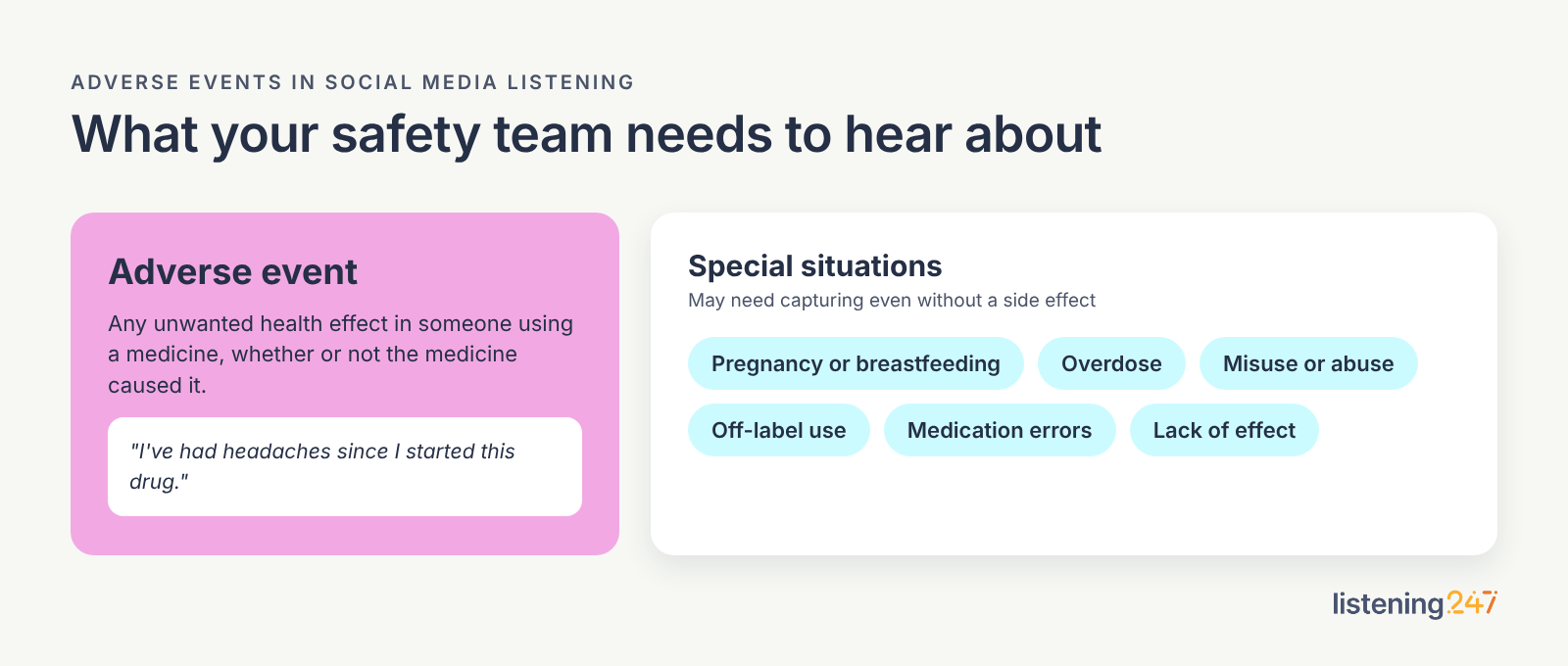
An adverse event is any unwanted health effect in someone using a medicine, whether or not the medicine caused it. A patient posting "I've had headaches since I started this drug" is describing a possible adverse event, even if the headaches have nothing to do with the drug.
Pharmacovigilance teams also care about special situations, which may need to be captured even when there is no side effect. These include:
- Use during pregnancy or breastfeeding
- Overdose, misuse or abuse
- Off-label use
- Medication errors
- Lack of effect
What the rules say about online sources
In the EU, the European Medicines Agency's Good Pharmacovigilance Practices (GVP Module VI) says marketing authorisation holders should regularly screen the internet and digital media under their management or responsibility for possible adverse reaction reports. If they become aware of a report on a website they don't manage, it should be assessed to see whether it qualifies for reporting.
A report is only valid when it has four minimum elements:
- An identifiable reporter
- An identifiable patient
- A suspected medicinal product
- A suspected adverse reaction

In the EU, serious valid reports must be submitted no later than 15 calendar days after the information is first received. Other regulators, including the FDA, work on the same principle: once a company is aware of a possible adverse event, it has to assess it.
Why most posts never become reports
Most social media posts are anonymous or missing key details, so they don't meet all four criteria. That is reassuring, but it doesn't remove the work. Every possible adverse event still has to be checked, and the decision has to be documented.
The real challenge is volume and accuracy. A brand can generate thousands of relevant posts a week. A tool that misses adverse events creates risk. A tool that flags everything buries your safety team in false alarms. Neither is acceptable.
Why not looking isn't the answer
Avoiding social listening doesn't make adverse events disappear from the internet. Your own channels still have to be screened, and posts can still reach you through employees, agencies or customers. Meanwhile, competitors that listen properly learn what patients and HCPs think of their brand, and of yours.
The safer route is to listen with a provider that is accurate enough to trust, and a process your pharmacovigilance team has agreed in advance.
What a good process looks like
- Agree the rules first. Before any data is collected, your safety team and provider agree what will be flagged, how it will be escalated, in what format and within what timeframe.
- Flag with high recall. AI models screen every post that mentions your product alongside a possible side effect or special situation. Missing a case is worse than reviewing an extra one.
- Confirm with people. A trained analyst reviews every flag. No automated decision decides what reaches your safety team.
- Check validity. The analyst checks each case against the four minimum criteria and records the outcome.
- Escalate on your terms. Valid cases and special situations go to your safety team on your timelines, in the format your SOP requires.
- Keep a full audit trail. Every flag, decision and handover is logged with timestamps, whether it was escalated or not.
- Reconcile regularly. Your safety team and provider compare records so nothing falls between the cracks.
Questions your pharmacovigilance team will ask
- How accurate is your adverse-event detection, and is that accuracy in the contract?
- Does a person confirm every flag before it reaches us?
- Can you follow our SOP, timelines and reporting format?
- What does your audit trail record, and can we inspect it?
- How are your analysts trained in pharmacovigilance?
- How do you handle personal data and anonymise reporting?
If a provider can't answer these clearly, your safety team is right to say no.
How listening247 handles adverse events
Every possible adverse event is flagged by AI, confirmed by an analyst and escalated to your safety team on your pharmacovigilance timelines, with timestamps and a full audit trail. Accuracy is written into the contract, with over 90% for adverse events, and models are retrained daily and improved with human-annotated posts whenever a mistake is spotted.
That gives your safety team the confidence to say yes, and your marketing team access to what patients, HCPs and carers are saying. Read more in our guide to social listening for pharma, or see how it works for your brand with a free brand snapshot, presented in a 15-minute meeting.
FAQ
Does every social media post about side effects have to be reported?
No. Only posts that meet the four minimum criteria become valid reports. But every possible adverse event you become aware of has to be assessed, and that assessment should be documented.
Who is responsible for reporting, the provider or the pharma company?
The marketing authorisation holder remains responsible. A listening provider flags, confirms and escalates cases so your safety team can assess and report them.
Can social listening be run safely in pharma?
Yes, when it is accurate and backed by a documented process with human confirmation, agreed timelines and a full audit trail.


