


Michalis A. Michael
November 26, 2026
Prescribing data tells you whether a launch is working. It doesn't tell you why.
What patients, HCPs and carers say in the first 90 days shows whether a launch is on track. Here's what to track each month.
Most drug launches are judged early. A McKinsey analysis of 210 launches found that about two-thirds missed their first-year sales forecasts, and those that started behind usually stayed behind for the next two years. More recently, ZS found that successful launches could be told apart from the rest by month three, using prescribing data alone.
Prescribing data tells you whether a launch is working. It doesn't tell you why. By the time a problem shows up in the numbers, patients, doctors and carers have often been talking about it online for weeks: an injection device that's hard to use, an insurance approval that keeps getting rejected, a side effect nobody mentioned.
This guide sets out what to listen for in each month of the first 90 days, who to listen to, and what to do with what you hear.
Before launch: set your baseline
Start listening at least a month before approval. You need to know how much people already talk about the disease, the current treatments and your competitors, or you won't be able to tell whether the launch moved anything.
Track patients, healthcare professionals (HCPs) and carers separately from day one. They talk in different places, worry about different things and need different responses.
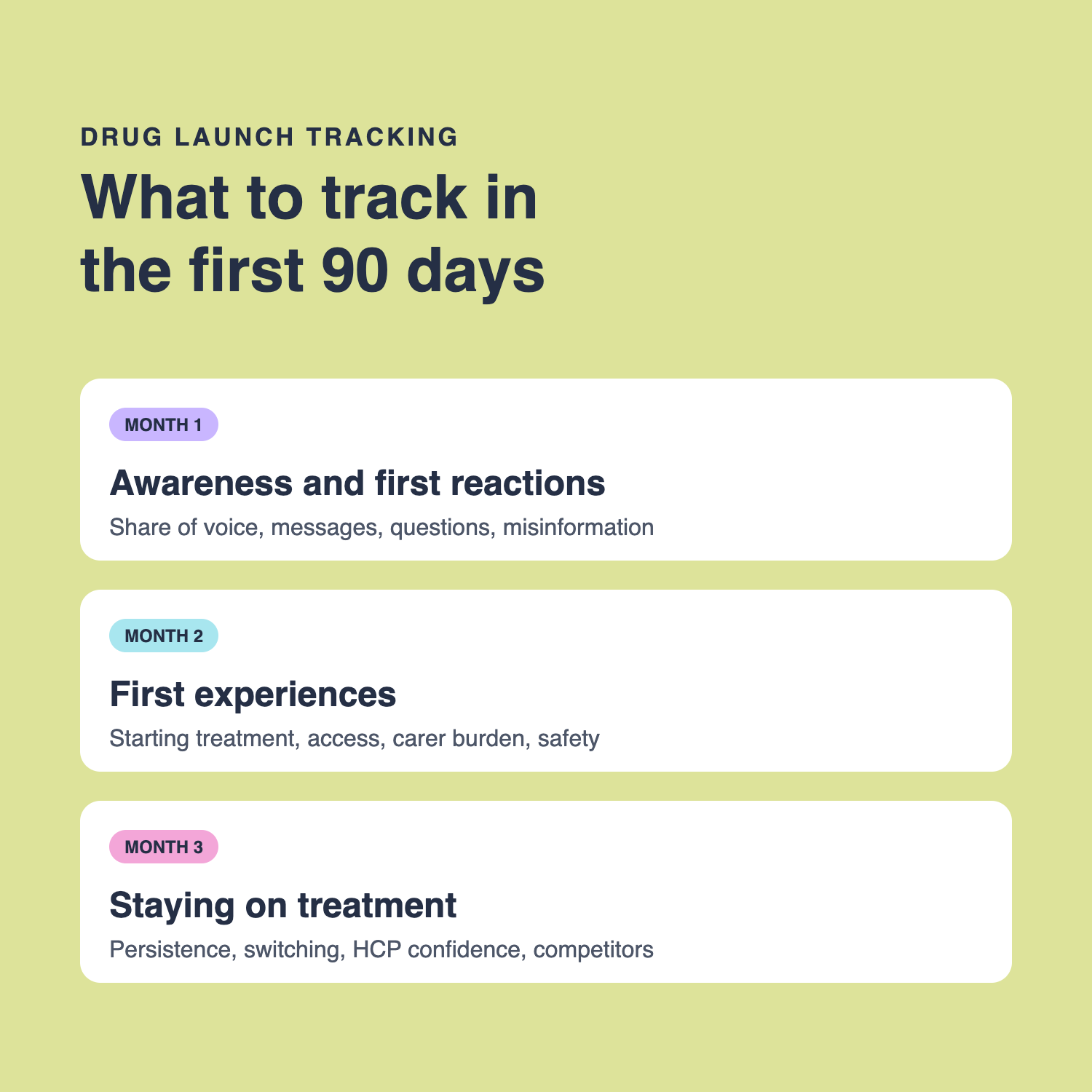
Month 1: awareness and first reactions
The question in month one is simple: does anyone know you've launched, and what do they think it is?
- Share of voice: how much of the conversation about the disease mentions your brand, compared with each competitor.
- Message pull-through: whether people repeat your key claims, or describe the drug in ways you didn't intend.
- Questions: what patients and carers ask about eligibility, dosing and cost. Repeated questions point to gaps in your materials.
- Misinformation: wrong claims about efficacy, safety or price, caught before they spread.
- HCP first impressions: how doctors and nurses react to the label, the data and the launch congress presentations.
Month 2: first experiences
By the second month, the first patients have started treatment. Conversations shift from what the drug is to what it's like to take.
- Starting treatment: experiences with the device, the dosing schedule and the first weeks of side effects.
- Access: insurance rejections, prior authorisation problems, pharmacy stock and out-of-pocket costs. ZS links slow early prescribing to access, awareness and targeting problems, and this is where they show up first.
- Carer burden: what changes for the people who help with injections, appointments and side effects.
- Possible adverse events: any post that may describe an adverse event goes to your safety team, not just into the report.
Month 3: staying on treatment and switching
In month three, the question becomes whether people stay. ZS found that return prescribing, doctors writing the drug again for new patients, separates good launches from weak ones a few months in.
- Persistence: why patients stop, pause or skip doses.
- Switching: who is switching to you, from which competitor, and why. And who is switching away.
- HCP confidence: whether doctors describe results in their own patients, which usually comes before repeat prescribing.
- Competitor response: new claims, price moves or patient programmes from competitors, and how people react to them.
The signals at a glance
- Share of voice (patients, HCPs, carers) shows whether the launch is being noticed. Use it to adjust media and medical education spend.
- Message pull-through (patients, HCPs) shows whether your positioning lands. Rework the messages that don't stick.
- Access problems (patients, carers) explain why early prescribing is slow. Brief market access and patient support teams.
- Treatment experience (patients, carers) shows what helps or hurts adherence. Improve onboarding, device training and support.
- HCP confidence (HCPs) shows whether repeat prescribing will follow. Focus field teams on the doubts that keep coming up.
- Switching (patients, HCPs) shows who you're winning and losing to. Sharpen your competitive messaging.
Setting it up safely
The biggest worry pharma teams have about launch listening is adverse events. Once a post that may describe one is in your data, your company may have to assess it. That's why many teams avoid social data altogether, and miss what it can tell them at launch.
The answer is to agree the process with your safety team before launch, not after:
- Agree the rules up front. Decide with pharmacovigilance which sources you'll monitor, what counts as a possible adverse event and how quickly it must reach them.
- Have people check every flag. Automated models find possible adverse events, but an analyst should confirm each one before it's escalated, so your safety team isn't flooded with false alarms.
- Keep a full record. Log every flag, decision and handover, so you can show what happened to each post during an audit.
- Keep personal data to a minimum. Anonymise posts and handle data under the data protection laws of each market.
We cover this in more detail in our guide to adverse events and social media listening.
Turning what you hear into action
A launch moves fast, so a quarterly report is too late. In the first 90 days, review findings every week and give each one an owner:
- Brand and marketing: share of voice, message pull-through and misinformation.
- Medical affairs: HCP questions, doubts about the data and early clinical impressions.
- Market access: insurance rejections, prior authorisation and pricing complaints.
- Patient services: onboarding, device problems and carer burden.
- Pharmacovigilance: every confirmed possible adverse event, through the process you agreed before launch.
For example, if patients in one market keep posting about rejected insurance claims in week six, market access can act weeks before slow prescribing shows up in the sales data.
Don't forget AI assistants
Patients and carers are starting to ask ChatGPT, Gemini or Perplexity about new treatments. Those answers are built from what's published online, so they can repeat outdated information or leave a new drug out entirely. In launch month, check what the main AI assistants say about your treatment and which sources they rely on. Where those sources are wrong or missing, your medical and communications teams know where to focus.
See what people are saying about your brand
Want to know where your launch stands? Request a free brand snapshot: your brand against a competitor, with patients, HCPs and carers analysed separately, presented by our analysts in a 15-minute meeting. For the wider picture, read our guide to social listening for pharma.
FAQ
When should we start listening for a launch?
At least a month before approval. Without a baseline of how people already talk about the disease and your competitors, you can't measure what the launch changed.
How is this different from prescription data?
Prescription data shows what happened. Social listening shows why, and often weeks earlier, because people post about access problems, side effects and doubts before they show up in the numbers.
Which audiences should we track?
Patients, HCPs and carers, each analysed separately. They use different channels and care about different things, so mixing them hides the signals that matter.
What happens if we find a possible adverse event?
An analyst confirms it and it goes to your safety team through the process you agreed before launch, with a full record of every step.


