


Michalis A. Michael
November 2, 2026
A brand can lead patient conversation and still trail with the prescribers who decide.
How pharma teams track HCP sentiment online, what prescribers talk about, and how to read it alongside field and market research.
What healthcare professionals (HCPs) think of a treatment shapes whether it gets prescribed. Pharma teams usually learn this through field force feedback, market research, advisory boards and conversations with key opinion leaders. All of these are valuable, and all of them are periodic.
HCPs also talk about treatments online, every day. Tracking that conversation gives brand, medical and insights teams a continuous view of prescriber sentiment between research cycles.
Where HCPs talk online
HCP conversations happen in more places than most teams expect:
- Professional profiles and posts on social networks
- Medical blogs and newsletters
- Comment sections on medical news sites
- Discussion around congresses and new data releases
- Video channels and podcasts
- Professional forums and communities, some of which can be included when you give access
What HCP conversations reveal
HCPs talk differently from patients. Their posts are more clinical and often more critical, which makes them especially useful for:
- Prescribing rationale. Why they choose one treatment over another.
- Switching triggers. What makes them move patients to a competitor.
- Evidence gaps. The data they want to see before prescribing more widely.
- Safety concerns. Side effects they are seeing or worried about, which your pharmacovigilance team needs to hear about too.
- Access frustrations. Coverage and reimbursement barriers that stop them prescribing.
- Reactions to new data. How trial results and congress presentations land with prescribers.
Why HCP sentiment has to be measured separately
Patients usually post far more than HCPs. If you measure sentiment across all conversation, patient voices dominate and HCP views disappear. A brand can lead patient conversation and still trail with the prescribers who decide.
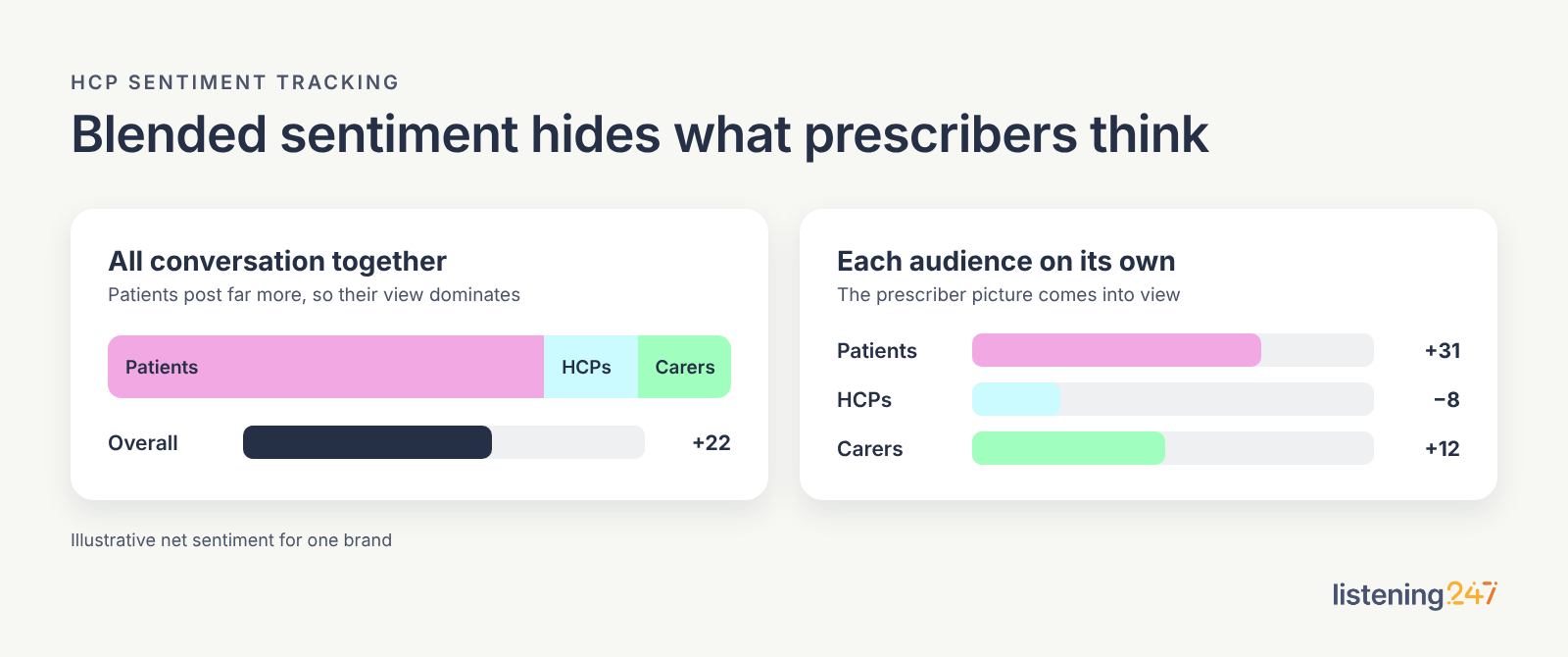
HCP language also needs its own models. A word that signals frustration from a patient can be a neutral clinical observation from a doctor. Sentiment has to be scored within each audience, not across all of them.
How HCPs are identified
Classifying a post as coming from an HCP relies on several signals: professional credentials in a profile, clinical language, and the context of the conversation. AI models do the first pass, and analysts check samples to keep the classification accurate. No method is perfect, which is why accuracy targets should be agreed and measured.
Turning HCP sentiment into action
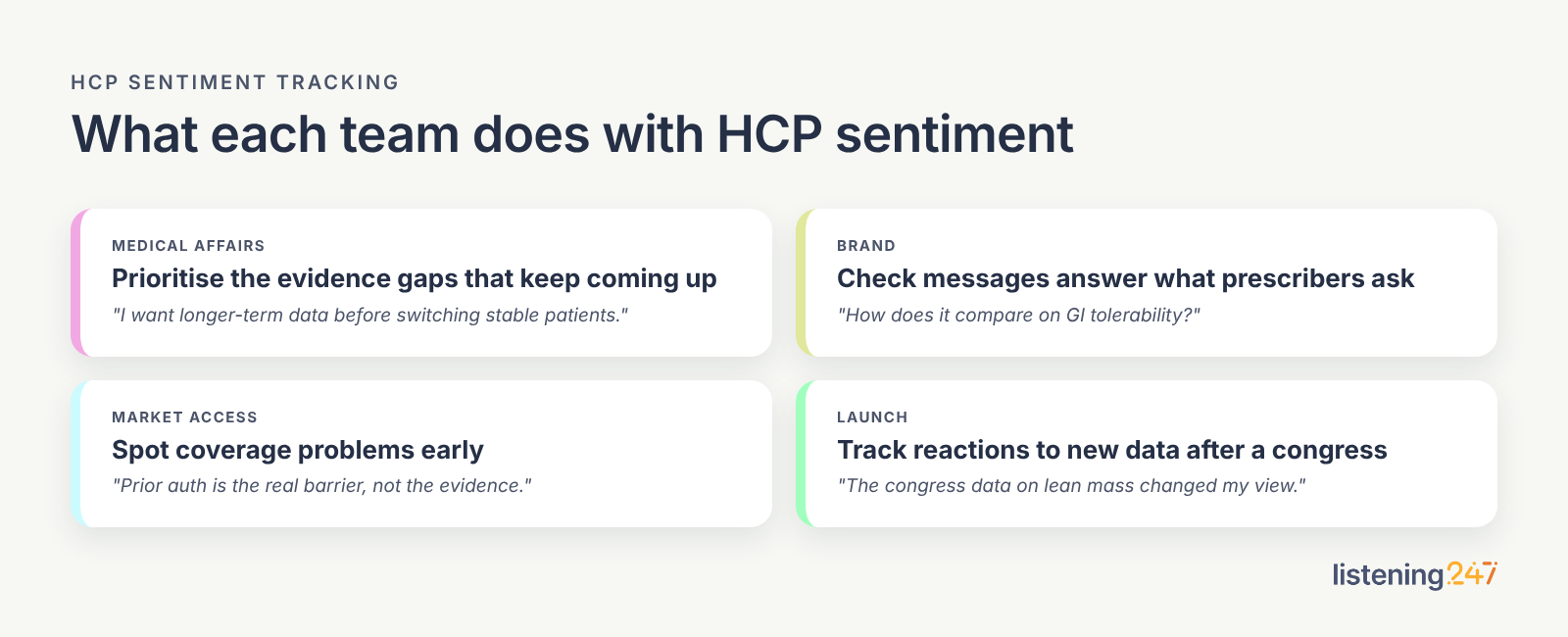
- Medical affairs can see which evidence gaps keep coming up and prioritise publications, medical education or field medical conversations.
- Brand teams can test whether their messages answer the questions prescribers are actually asking.
- Market access teams can spot coverage problems early.
- Launch teams can track how prescribers react to new data in the weeks after a congress.
What it can't tell you
Online HCP sentiment can't tell you how prescribers will react to a product that isn't on the market yet, because nobody is discussing it. For pre-launch questions, advisory boards and research are still the tools.
Posts from HCPs can also describe adverse events. Those need to be confirmed and escalated to your pharmacovigilance team through an agreed process, as explained in our guide to adverse events in social media listening.
How listening247 helps
listening247 analyses patients, HCPs and carers separately, with custom models trained only for your therapeutic areas. Accuracy is written into the contract: at least 80% F1 on sentiment and topics, 90% on brand relevance and over 90% for adverse events. Insight reports and recommendations arrive at the cadence you prefer, and every possible adverse event is confirmed by an analyst and escalated to your pharmacovigilance team on your timelines.
Read our full guide to social listening for pharma, or see how HCPs talk about your brand with a free brand snapshot, presented in a 15-minute meeting.
FAQ
Can you track HCPs on closed professional networks?
Some professional communities can be included when you give us access. Others remain closed, and a good provider is clear about what it can and can't see.
How is HCP sentiment different from patient sentiment?
HCPs focus on evidence, efficacy, safety and access, and use clinical language. Their sentiment has to be measured separately so it isn't drowned out by the larger volume of patient posts.


