


Michalis A. Michael
November 2, 2026
Surveys can only measure what you thought to ask about. Patients online raise the problems you didn't know existed.
Surveys tell pharma what patients answer. Social listening shows what they say unprompted. Here's what each method misses and how to use both.
Most pharma teams learn about patients through surveys, interviews, advisory boards and patient support programmes. These methods are valuable, but they share one limit: they only hear the answers to the questions you ask.
Social listening adds what patients say when nobody is asking. This article looks at what each approach does well, where each one falls short, and how to combine them.

What surveys do well, and where they stop
Surveys and interviews are good at measuring things you already know matter. You can size a problem, compare segments and track change over time with a structured sample.
Their limits are well known:
- You only learn what you ask. A question that isn't in the survey never gets answered.
- Memory fades. Patients are asked to recall side effects or experiences weeks or months later.
- People answer politely. Respondents often say what they think the researcher wants to hear.
- Some patients are hard to reach. In rare diseases, recruiting enough respondents can take months.
- It's slow. Annual or quarterly studies miss what happens between waves.
What patients say when nobody is asking
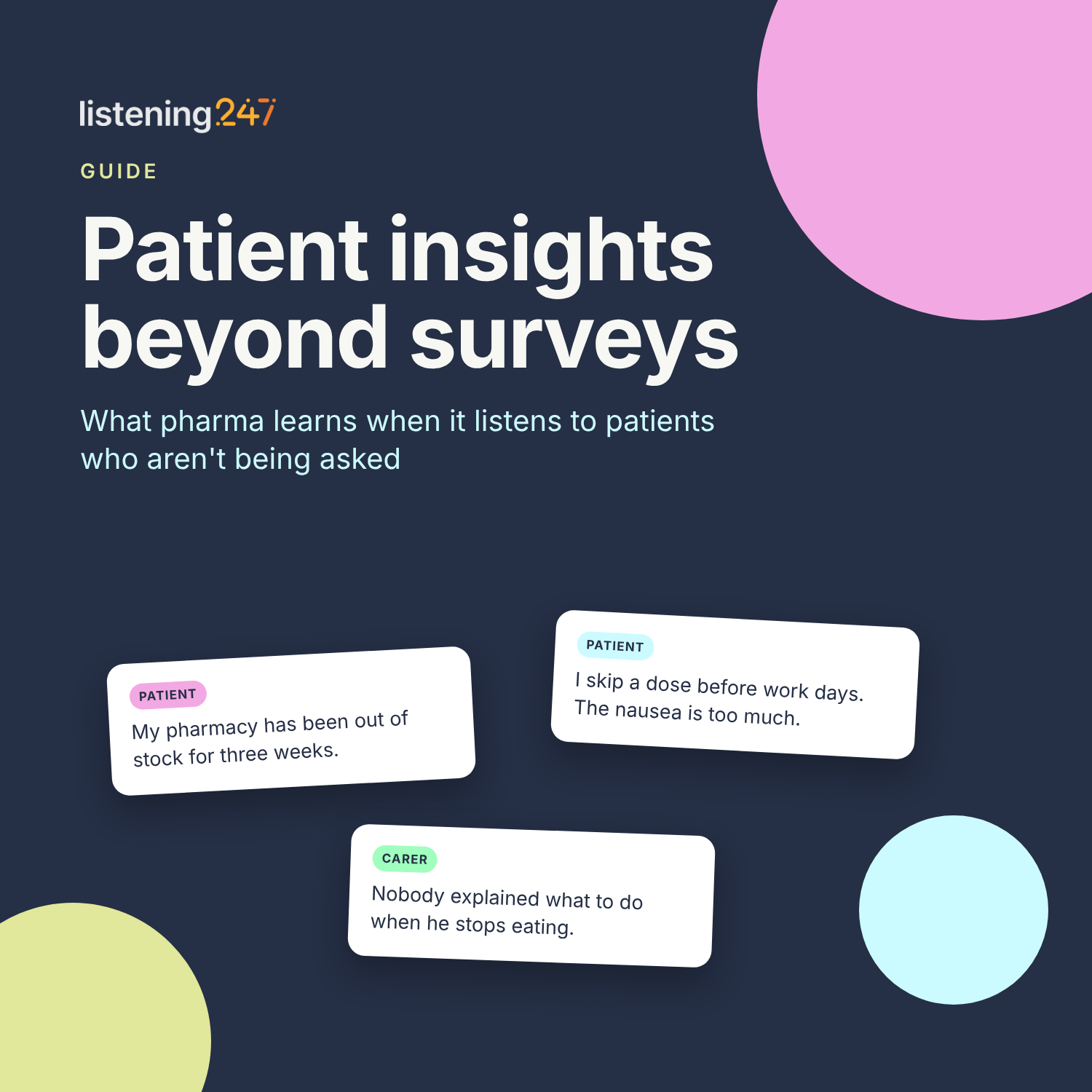
Online, patients talk about their condition and treatment in their own time and their own words. The topics that come up are often the ones research didn't plan for:
- Access and cost. Insurance changes, prior authorisations, pharmacies running out.
- Side effects in daily life. Not just what happened, but how it affected work, sleep or family. Posts like these can describe possible adverse events, so they also matter to your pharmacovigilance team.
- Adherence and stopping. Why patients skip doses, switch or stop treatment.
- Information gaps. Questions their doctor didn't answer, or answered too quickly.
- The emotional side. Fear, frustration, relief and hope that rarely show up in a rating scale.
Carers add another layer. Partners, parents and adult children often describe the practical burden of a condition more clearly than patients do.
Where listening goes further
It finds what you didn't know to ask. New themes surface on their own, from a confusing injection device to a rumour about a competitor.
It's continuous. Conversations react within hours to a trial readout, a supply problem or a news story, so you see shifts as they happen.
It uses their words. Patients rarely say "gastrointestinal tolerability". They say "I felt sick for a week". That language makes patient materials, messaging, organic posts and ads more effective.
It reaches small communities. In rare diseases, patient forums and groups are often where the most detailed conversations happen.
What listening can't do
Listening can't tell you what people think of a product that isn't on the market yet, because nobody is talking about it. For that, you still need surveys, interviews and concept tests.
Use both together
Listening and research work best as a pair:

- Listen to find the themes. Use social data to discover what patients care about right now.
- Research to size them. Add the most important themes to surveys or interviews to measure how widespread they are.
- Borrow their language. Write survey questions and materials in the words patients actually use.
- Track between waves. Use listening to see what changes between research cycles, so nothing catches you by surprise.
How listening247 helps
listening247 runs always-on programmes for each of your therapeutic areas and brands. Patients, HCPs and carers are analysed separately, with insight reports and recommendations at the cadence you prefer. Every possible adverse event is confirmed by an analyst and escalated to your pharmacovigilance team on your timelines, with a full audit trail.
Read our full guide to social listening for pharma or our guide to adverse events in social media listening, or see what patients are saying about your brand with a free brand snapshot, presented in a 15-minute meeting.
FAQ
Can social listening replace patient surveys?
For products already on the market, it answers many of the same questions, unprompted and in real time. For a product that hasn't launched, you still need surveys, interviews and advisory boards.
Is social listening useful for rare diseases?
Often, yes. Patient communities for rare conditions tend to be small but very active, and their conversations can be more detailed than what a short survey captures.


