


Michalis A. Michael
October 30, 2026
Teams that avoid social listening don't avoid adverse events. They just miss what patients, HCPs and carers are saying.
How pharma and biotech teams use social listening to hear patients, HCPs and carers, and how to handle adverse events safely.
Social listening for pharma is the analysis of online conversations about diseases, treatments, brands and drugs, split by who is speaking: patients, healthcare professionals (HCPs) and carers. Done well, it tells your teams what people really think, in their own words, at the cadence you choose instead of once a quarter. Done badly, it creates compliance risk and a dashboard nobody reads.
This guide explains how it works, what makes pharma different from other industries, and what to ask before you choose a provider.
What is social listening for pharma?
Social listening means collecting online posts from social media, forums, patient communities, blogs, reviews, news and video, then using AI and analysts to find the themes, sentiment and questions inside them.
In most industries, that is where it ends. Pharma needs three more things:
- Audience separation. A patient describing side effects and an oncologist discussing trial data are not the same signal. Mixing them hides both.
- Adverse-event handling. Posts that describe a possible side effect may need to be reported to the manufacturer's safety team.
- Medical language. Models have to understand drug names, conditions, dosing talk and slang, often across several languages.
Why pharma teams use it
Traditional research asks people questions. Social listening hears what they say when nobody is asking. That difference matters in three ways.
It is unprompted. Surveys and interviews can only measure what you thought to ask about. Online, patients raise the problems you did not know existed: a pharmacy that keeps running out, an injection pen that is hard to use, an insurer that changed its rules.
It is continuous. Most brand teams see patient and HCP opinion through quarterly tracking studies or annual market research. Online conversation reacts within hours to a trial readout, a label change or a supply problem. Listening shows the shift while there is still time to respond.
It uses their words. Patients rarely say "gastrointestinal tolerability". They say "I felt sick for a week". Knowing the language people actually use makes messaging, patient materials, organic posts and ads more effective.
For products already on the market, listening answers many of the questions research is used for. The one thing it can't do is tell you what people think of a product that hasn't launched yet.
Three audiences, analysed separately
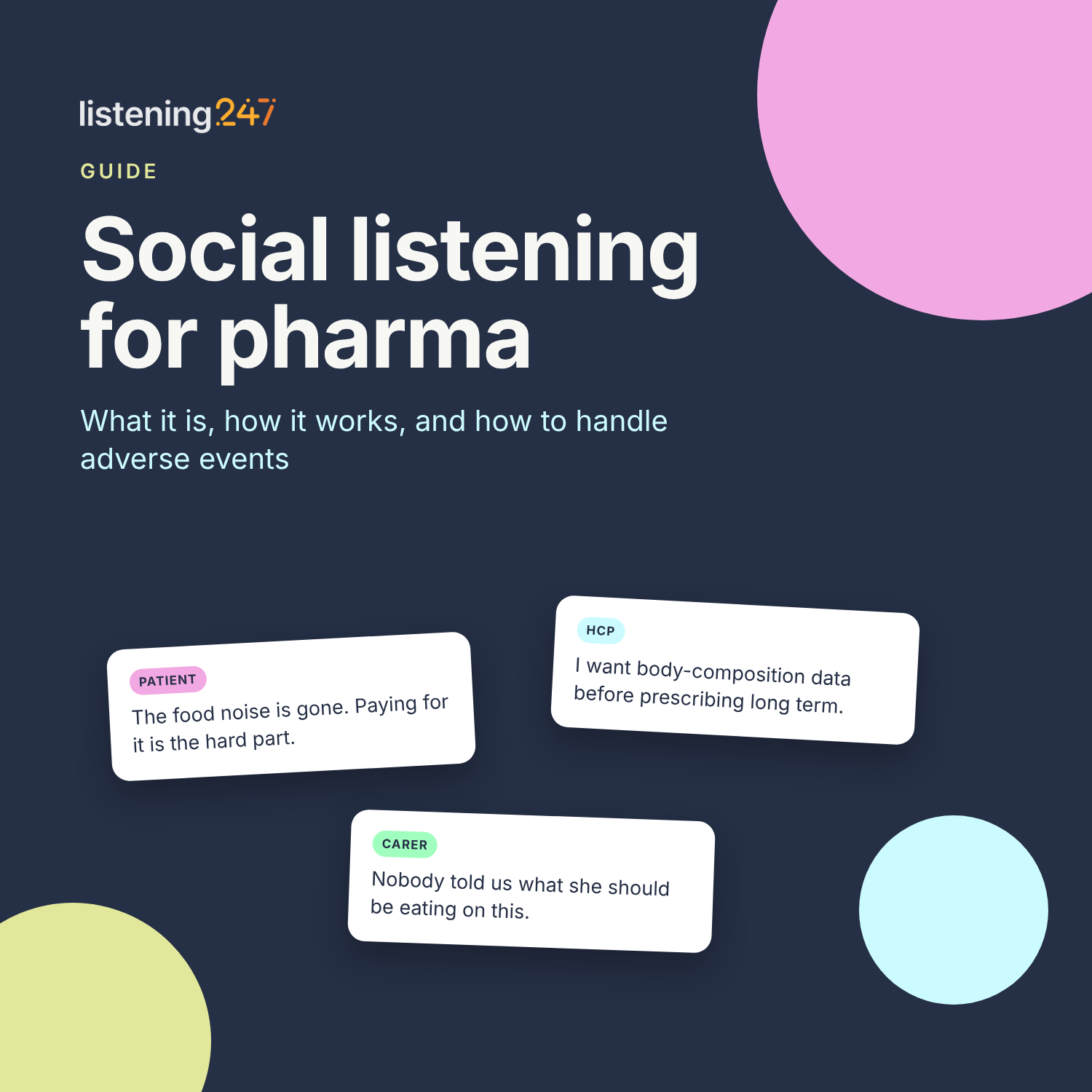
The most common mistake in pharma listening is treating "online conversation" as one voice. There are three main voices, and each one tells you something different.

- Patients talk about treatment experience, side effects, cost and access, and unmet needs.
- HCPs talk about why they prescribe, switch or hesitate, how they compare treatments, and where the evidence falls short.
- Carers talk about the daily burden of a condition and the practical support they are missing.
Keeping them separate changes the conclusions. A brand can lead patient conversation and still trail with prescribers. Overall volume would hide that, because patients usually post far more than any other group.
How it works, step by step

- Define the scope. Choose the therapeutic areas, brands, competitors, markets and languages. A focused scope gives clearer answers than "everything about our company".
- Collect the data. Gather posts from social media, forums, patient communities, blogs, reviews, news and video, plus subscription or password-protected sources when you give access.
- Remove the noise. Filter out spam, ads, news reposts and irrelevant mentions. In pharma, noise can be most of the raw volume.
- Classify the speaker. AI models identify whether a post comes from a patient, an HCP or a carer, with analysts checking samples.
- Find themes and sentiment. Models group posts into topics and score sentiment within each audience, not across all of them.
- Screen for adverse events. Possible adverse events are flagged and confirmed by trained analysts before anything else happens (more on this below).
- Turn it into recommendations. Analysts write what changed, why it matters and what to do about it.
The adverse-event question
Adverse events are the main reason pharma companies hesitate to listen. The worry is simple: once a post is in your data, you may be responsible for reporting it on time, and a missed report can lead to regulatory findings and serious fines. So many teams don't gather social media posts at all, and miss out on the marketing value.
An adverse event is any unwanted health effect in someone using a medicine, whether or not the medicine caused it. Under ICH guidelines, a report is only valid when it has four minimum elements: an identifiable patient, an identifiable reporter, a suspect product and an adverse event. Most anonymous social posts do not meet all four, but each one has to be checked.
That is not a reason to stay away. It is a reason to listen with an accurate provider and a process in place:

- Screen everything. AI flags every post that mentions your product alongside a possible side effect or special situation, such as pregnancy exposure or misuse.
- Confirm with people. A trained analyst checks each flagged post against the four criteria. No automated decision decides what reaches your safety team.
- Escalate on your terms. Valid cases go to your safety team on your pharmacovigilance timelines, in the format you set.
- Keep an audit trail. Every flag, decision and handover is logged with timestamps, whether it was escalated or not.
With that process agreed up front, listening becomes a controlled source of safety signals rather than a risk.
Two teams, two jobs
Social listening in pharma serves two different teams, and both need to trust it.
Marketing and insights use it to track how their brand is talked about against competitors, spot access and cost problems early, see which evidence gaps HCPs keep raising, understand what carers need, and test whether messages, organic posts and ads match the language patients use.
Pharmacovigilance needs confidence that every possible adverse event will be caught and escalated correctly. Their sign-off is what allows marketing to use social data in the first place.
Questions to ask a provider
General social listening tools were built for consumer brands. Before you choose one for pharma, ask:
- Do you separate patients, HCPs and carers, and how accurate is that classification?
- What is your adverse-event process, and does a person confirm every flagged post?
- Can your escalation follow our pharmacovigilance SOP and timelines?
- How do you protect personal data and anonymise what you report?
- Which languages and markets do your models cover, and is accuracy written into the contract?
- Do we get a dashboard to staff ourselves, or analysts who tell us what it means and what to do?
- Can we see results on our own brand before committing?
A provider who cannot answer the second question clearly is not ready for pharma.
How listening247 does it
listening247 runs Therapeutic Area Intelligence, an always-on programme for each of your therapeutic areas and brands, run by our analysts. Patients, HCPs and carers are analysed separately, with insight reports and recommendations at the cadence you prefer. Every possible adverse event is confirmed by an analyst and escalated to your safety team with a full audit trail.
Accuracy is written into the contract: at least 80% F1 on sentiment and topics, 90% on brand relevance and over 90% for adverse events. Models are trained only for you, retrained daily and improved with human-annotated posts whenever a mistake is spotted.

The easiest way to see it is a free brand snapshot: your brand against a competitor, by audience, presented by our analysts in a 15-minute meeting.
I'm the lead author of AI Powered Insight (Routledge, 2026), on how AI is changing market research.
FAQ
Is social listening compliant for pharma companies?
Yes, when personal data is kept to a minimum and anonymised, and there is a documented adverse-event process with human confirmation and escalation to your safety team.
Does social listening replace market research?
For products already on the market, it answers many of the same questions, unprompted and in real time. For a product that hasn't launched, you still need surveys, interviews and advisory boards.
Can you listen to HCPs online?
Yes. Many HCPs post on social networks, blogs and forums, and some professional communities can be included when you give us access.
How do we get started?
Most teams start with a free snapshot of their brand against a competitor, presented in a 15-minute meeting. Then we talk through what an always-on programme would look like for your therapeutic areas.


